
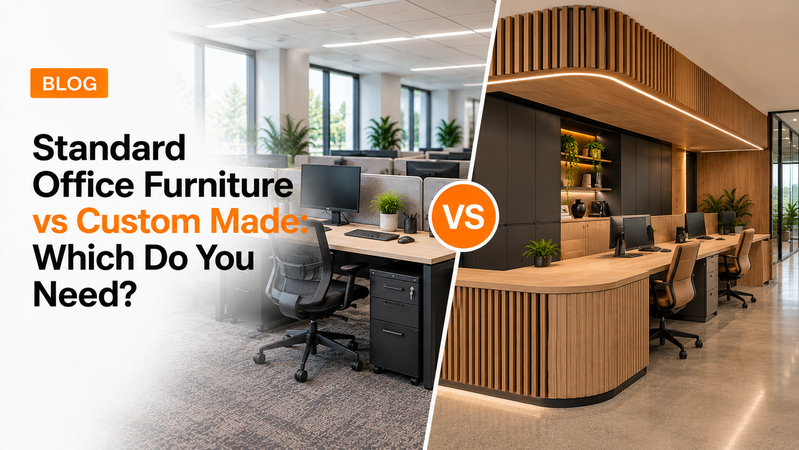
Not every workplace needs custom-made furniture.
For many offices, standard desks, workstations and storage provide everything required at a competitive price. But some spaces have unusual dimensions, specific operational requirements or design challenges that standard furniture simply can't solve. Knowing when to choose standard furniture and when to consider custom can help businesses spend their fitout budget where it matters.
When Standard Furniture Makes Sense
Standard office furniture is a practical choice for many workplaces.
It's particularly suitable when:
- The room has a straightforward layout
- Standard desk sizes fit comfortably
- Furniture is required relatively quickly
- The business wants easy future expansion
- Budget is a major consideration
With the range of sizes and configurations now available, standard furniture can accommodate a large percentage of office layouts.
When Custom Furniture Becomes Useful
Custom furniture becomes valuable when the room or the way it is used creates specific requirements.
This might include an unusually shaped room, a reception counter built around a particular workflow, a large custom boardroom table or workstations designed to maximise a difficult floorplan. Instead of making the room fit the furniture, the furniture can be designed around the room.
Making Better Use of Space
One of the biggest advantages of custom furniture is the ability to use available space more efficiently.
Standard furniture comes in predetermined sizes. Custom furniture can be designed around walls, columns, corners and other architectural features that might otherwise create unused space.
Custom Doesn't Have to Mean Everything
A fitout doesn't need to be completely custom.
Often the best solution is a combination. Standard task chairs, storage and meeting furniture might be paired with custom workstations or a purpose-built reception counter. This allows businesses to invest in custom pieces where they provide the greatest benefit.
Consider Finishes and Branding
Custom furniture also provides greater control over colours, finishes and configurations.
This can be particularly valuable in reception areas, boardrooms and customer-facing spaces where the furniture forms an important part of the overall interior.
Think About Future Changes
Before commissioning custom furniture, consider whether the workplace is likely to change.
Highly specialised furniture may be perfect for its original location but less flexible if teams move or the office is reconfigured later. Good planning should consider both current requirements and reasonable future changes.
Compare the Complete Solution
Price shouldn't be the only comparison.
Consider how well the furniture uses the available space, how long it is expected to remain in service and whether a standard solution requires compromises elsewhere in the layout. Sometimes standard furniture is clearly the better choice. In other situations, a custom solution can solve problems that would otherwise remain for years.
Final Thoughts
The decision between standard and custom office furniture depends on the workplace.
If standard furniture fits the room and performs the required job, there's little reason to complicate things. When the space has unusual dimensions or the business has specific functional requirements, custom furniture can provide a solution designed around exactly how the workplace needs to operate.